After my initial training at the Mussoorie Academy, I was appointed Assistant Collector (Under Training) in Wayanad in June 1991. According to my counsellor at the Academy, Wayanad was not a regular training district. Michael sir, the District Collector, later told me how he had persuaded the then Chief Secretary to let me work with him there, on the condition that I would remain in Wayanad for as long as he was posted as Collector.
When Michael sir was transferred from Wayanad in August 1991, my own transfer became imminent. My posting to Kollam marked the end of my brief tenure in Wayanad and the beginning of a new chapter in a new place.
I arrived in Kollam with the usual mixture of curiosity and uncertainty that accompanies a new posting. A new place meant new people, unfamiliar surroundings and, above all, a new working environment.
During our stay in Thiruvananthapuram, we went to call on the new Chief Secretary, Mr S Padma Kumar. He mentioned Shri Paul Antony, the District Collector of Kollam, and told me that he was sending me to a good Collector for my training. He was absolutely right.
My training with Paul sir became an amazing and landmark chapter in my service life. It began, interestingly enough, with our contrasting food habits. He was a staunch non-vegetarian, while I was the exact opposite. This made life rather difficult for Neena madam, who had to prepare food for both of us! Kollam was not a place where a vegetarian had much choice at the time, so I became a regular at the Collector’s Bungalow for food. Neena ma’am picked up culinary skills from some of our North Indian colleagues in the cadre, perhaps partly out of necessity.
The bond between the District Collector and the AC (U/T) soon became very strong. Paul sir and Neena madam have guided us ever since in our professional and personal decisions, something that we will always cherish.
Paul sir is an epitome of hard work, sincerity and the courage to speak his mind. He also had a way of introducing me to the practical side of administration without making it feel like a formal lesson. Through him, I began to understand that government offices had their own rhythm. Much of administrative work depended not merely on rules, but also on the people who interpreted and implemented them.
Paul sir took a special interest in my training and ensured that I followed the schedule prescribed in the Training Manual. As part of the schedule, an Assistant Collector (Under Training) had to send a weekly report on his work to the Member, Board of Revenue. So, I began sending my weekly reports to Dr D Babu Paul.
Babu Paul sir actually read those reports. More importantly, he commented on various parts of them, often relating my observations to his own experience in revenue administration.
I still recall one such report. It concerned the acquisition of land for an irrigation project in the district. The RDO was the Land Acquisition Officer, and since I was undergoing training in the RDO’s office, I attended the negotiations.
The discussions went on for about seven hours. We finally left the office at around 10 p.m., without reaching a settlement. In my report, I described the negotiations as a futile exercise that had produced no results. I also observed that we had the option of invoking the urgency clause and taking possession of the land parcels.
Babu Paul sir had a different view.
In his comments, he narrated how, as District Collector of Idukki, he had once conducted negotiations in a similar case. Those discussions had continued until 2 a.m. without producing any result. Later that morning, the Chief Minister was visiting Idukki, and Babu Paul sir went to receive him at 6 a.m. When Shri C Achyuta Menon looked at him, he asked whether he had not slept well. Babu Paul sir told him what had happened the previous night.
Mr Menon asked him to go, take some rest and meet him at 11 a.m. in the Guest House. It was a very noble gesture from a Chief Minister. I witnessed similar consideration in some of my own encounters with political bosses during the early years of my service.
Babu Paul sir’s comments also taught me that an apparently unsuccessful negotiation was not necessarily a futile exercise. Consultation, patience and the effort to arrive at an agreement were themselves important parts of the administrative process.
My diligence in sending weekly reports, however, had an unintended consequence. Since I was sending my reports regularly and Babu Paul sir was reading them, he asked the other Collectors to obtain similar reports from their IAS trainees and forward them to him. This did not make me particularly popular among my friends in the cadre!
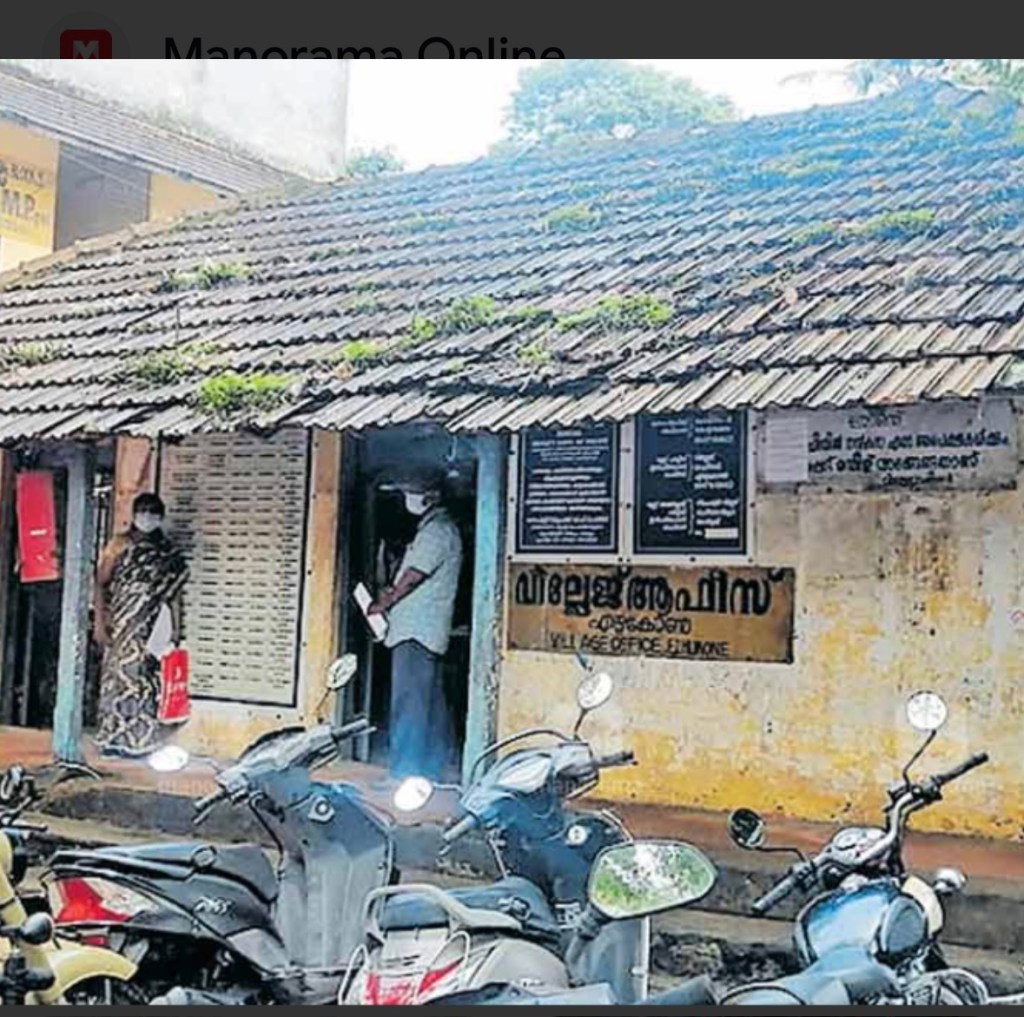
Paul sir continued to take a great deal of interest in my training, and he carefully selected the officials under whom I was to work. When it was time for my Village Office assignment, he personally interviewed a dozen Village Officers before selecting Mr Sivasankaran Pillai, the Village Officer of Ezhukone.
I was to be trained in Ezhukone village, about 20 kilometres from the district headquarters. Paul sir arranged a District Rural Development Agency (DRDA) vehicle for my commute. I found the vehicle a little too flashy for a trainee going to a Village Office, so I preferred travelling there by KSRTC bus.
That was how I arrived at the Ezhukone Village Office and met Mr Sivasankaran Pillai.
The Village Office was modest in appearance, with registers, land records, handwritten notes and old furniture. Besides the Village Officer, there were two Village Assistants and a Village Man.
Kerala villages are much bigger in terms of demography and facilities than what we see in North India. Ezhukone had a population of about 27,000 and had good schools, health centres, a bank and shopping facilities. The Village Office was an important point of contact between the government and the people of the locality. Villagers came there for applications, certificates, land records and other documents. Some came with matters that appeared routine. Others arrived carrying problems that had been weighing on their families for years.
When I met Sivasankaran Pillai, he told me that Paul sir had asked him to ensure that I received detailed exposure to the intricacies and complexities of identifying land through natural landmarks, conducting proper inspections, and understanding the different records and registers maintained at the Village Office.
I had to spend four weeks there. The first week was for training, and for the rest of the period, I was to work as the Village Officer.
The Ezhukone Village Office thus became my sandbox for my early lessons in public administration. It was a place where I could take decisions, issue certificates and conduct inspections, while still having an experienced and dependable officer beside me.
As I began to understand the position of the Village Officer, I remembered a story told to us by Mr Ramachandran Nair, a former Chief Secretary.
After his selection to the IAS in 1961, he returned home after completing one year of training at the Academy. One evening, while he was sitting with his siblings, a person came to meet him. His father came inside and told him about the visitor.
Since he was in the midst of a discussion, he requested his father to ask the person to wait.
After a few moments, his father returned and said, “Ada, he is an important person and should not be made to wait.”
When Ramachandran sir went outside, he found the local Village Officer waiting for him. The officer had come to meet and greet him after learning about his selection and posting in Kerala.
Such was the power and standing of a Village Officer.
Online service delivery and digitalisation have now diluted that authority to some extent. Even so, Village Officers can still wield considerable power in land-related matters.
Sivasankaran was a quiet, unpretentious and methodical officer. He examined documents and petitions carefully. Initially, I thought that his extra care was probably due to my presence. As I spent more time there, however, I realised that this was simply the way he worked.
He commanded a great deal of respect because of his simplicity, sincerity and responsive behaviour.
One very unusual thing I noticed was that he was always barefoot, whether he was sitting in the office or going out for an inspection. I found this rather awkward, especially when I accompanied him on inspections wearing my shoes and socks.
One day, I bought him a pair of leather chappals from a neighbourhood shop. He was reluctant to wear them and said that he was not comfortable in them. I insisted, telling him that I would not be able to go for inspections with a barefoot Sivasankaran accompanying me.
After a few days in the Village Office, Mr Pillai began explaining the registers and accounts to me. Some were permanent records, while others were maintained annually. There was the Settlement Register, the Basic Land Tax Register, the Mutation Register, the Building Tax Register and many more. In all, there were almost 16 registers and 21 accounts.
Jamabandi, the annual inspection and verification of village revenue records, was one of the important functions. The District Collector, Sub-Collector and Tahsildar conducted Jamabandi inspections. This system ensured that the senior district revenue officials visited every village in their jurisdiction at least once a year.
Sivasankaran Pillai’s method of dealing with people was simple but powerful. He did not sacrifice procedure in the name of sympathy. At the same time, he did not hide behind procedure to avoid dealing with people. What impressed me most was that he followed the rules carefully but dealt with people humanely.
As I worked in the Village Office, I realised more and more how important the institution was. For many citizens, it was the first point of contact with the government and its public administrators.
People came carrying old papers that were worn and had been folded several times. The papers were often kept in a polythene cover tied with a rubber band. Some had been preserved for years while the owners waited for the resolution of a dispute relating to a piece of land. Others needed a certificate to avail themselves of the benefits of a government scheme.
Often, a poor villager was simply looking for a response. It might not always be positive, but it needed to be clear and convincing enough for him to return with some hope or satisfaction.
Until my hands-on experience at the Village Office, I had thought of administration largely in terms of files, registers, rules and procedures.
The Ezhukone experience made me look at these things differently. I began to see that a revenue register was not merely a register. Behind a survey number, there could be a family. Behind a land record, there could be a history. Behind an application, there could be a citizen waiting for an answer that might affect his livelihood or his future.
The behaviour of a public servant at the counter could influence a citizen’s view of the entire government. I realised that a public office was not simply part of the machinery of government. It was the human face of government.
A citizen might never read a government rule or understand the structure of a department. But that citizen would remember the officer who listened to him, the official who explained the procedure, and the person who either helped him understand the next step or made him feel that his problem did not matter.
In that sense, public trust was built in very ordinary places. It was built in a Village Office. It was built when an officer took the trouble to examine an old document instead of dismissing it. It was built when a villager walked out of the office knowing what he had to do next.
The more time I spent there, the more I understood that good administration required more than knowledge of rules. It required patience, accuracy, fairness and respect for the people whom those rules were meant to serve.
While Kollam gave me my first real glimpse of administration, Ezhukone was where its human side became clear to me.
Sivasankaran Pillai retired from there a few years later, but the lessons I learnt from him remained with me through all my future assignments and throughout my service life (Unfortunately I don’t have his photo to share here but it is imprinted in my mind).


Leave a Reply