My posting as Sub-Collector Devikulam in August 1992 was as dramatic as my posting in Wayanad as Assistant Collector (U/T). We got our posting orders a little after we had reported for duty at the Kerala Secretariat. I was posted as Sub-Collector, Fort Kochi. I met Shri S. M. Vijayanand sir and, looking at my experience in the development sector, he felt Devikulam would have been more appropriate. So, he managed to get my sub-division changed through his goodwill and contacts.
Looking back, that change added some of the most memorable chapters to my life story. Had I not come to Devikulam, I would have missed out on many journeys, not because of where they led, but because of the people I met along the way.
Prashansa, my wife, joined me in February 1993. She accompanied me to various places. Devikulam being a large subdivision, I preferred to stay overnight in various parts of the subdivision. We also trekked in wildlife sanctuaries in Thekkady and Munnar, discovering the forest and its many moods together.
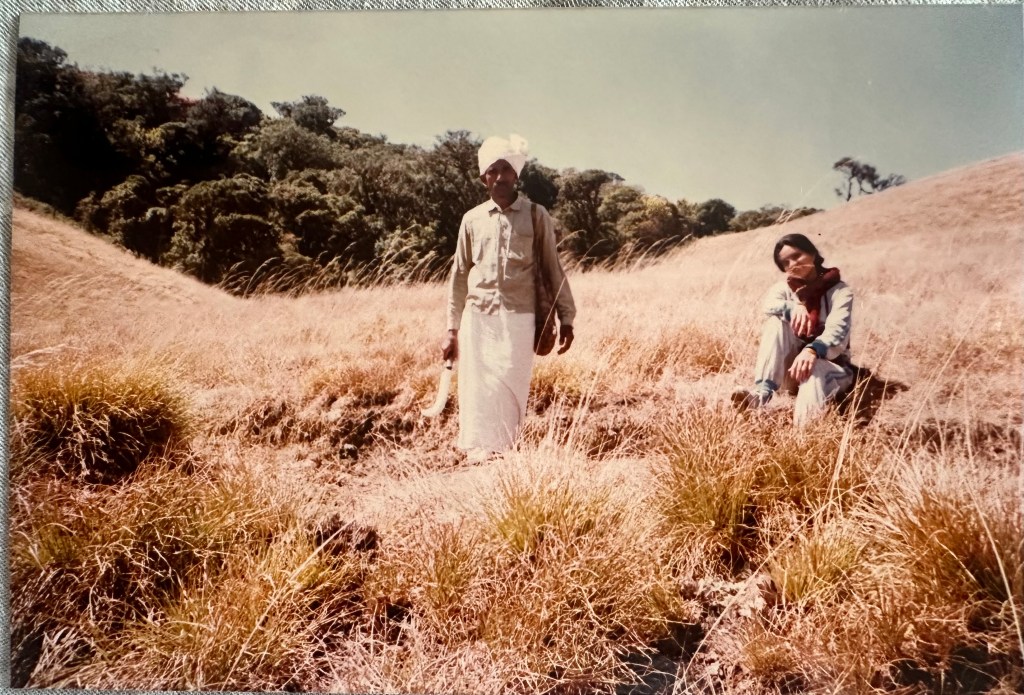
In April 1993, we had some holidays and decided to trek in the Eravikulam National Park. Never knew this was going to be one such journey that remains forever etched in my memory.
This forest trek was not very common. With no convenient roads, the forest and grasslands had to be negotiated on foot, over narrow trails, steep slopes and undulating terrain. Our friend, Mr. Sivadas, Assistant Wildlife Warden, Eravikulam National Park, arranged our trek. He identified one remote forest hut for our stay. Mindful of the wild animals on the way, he also arranged for a forest guard to accompany us, who knew the area well.
He was a local tribal named Krishnan Muthuvan.
I looked at the man: old, thin and lanky, barely 5 ft tall, perhaps in his late 50s. With a small sickle in his hand, he was dressed in a kurta and mundu, very unlike a forest guard. I must have looked a bit doubtful because Sivadas immediately assured me of his capabilities. And Krishnan was soon to prove him right.
For someone unfamiliar with the terrain, the trek could be challenging and quite daunting. There were vast grasslands and dense vegetation all around, with a few narrow trails and no obvious markers to guide us. But a bend in the trail, a particular tree, a ridge or a stream appeared to be enough for Krishnan to find the way.
He led us confidently, as though the forest had laid out a familiar path just for him. He knew the forest not from books or maps, but from his lifetime of experience in the area.
Before long, I understood why Sivadas had chosen him to accompany us.
As we walked, I initiated conversation to understand his capabilities and also to pass time as we travelled. He talked about his childhood memories, his encounters with bison, tiger and an elephant, and his love for Nilgiri Tahr.
Our talks gradually moved from the forest to his people, the Muthuvans. Although I had spent some years working with tribals in Madhya Pradesh, Gujarat and Bihar, I wanted to know more about the local tribes of Kerala.
I had heard of a tribal settlement in Chinnakanal, very near to Devikulam village, but had still not visited it. So, I was more curious to know about them.
Krishnan spoke about all this with an easy familiarity, describing each custom and tradition, their way of life and family systems, as though he was taking me through his own world.
And as we walked through that amazing landscape, I realised that I was learning anthropology, not in a classroom, but on a forest trail, from a man who had lived that culture.
Muthuvans are a distinctive indigenous forest-dwelling community of the Western Ghats, concentrated particularly in Idukki and adjoining Tamil Nadu. According to Krishnan, his forefathers had fled from Madurai many centuries ago, following the burning of the city, an episode narrated in some historical literature.
They are said to have carried the idol of their deity, Madurai Meenakshi, along with their children and belongings, carrying everything on their backs. The name Muthuvan is believed to be associated with this traditional practice of carrying loads on the back. They have their own dialect and a distinctive social organisation.
But what interested me was not merely the origin of their name. It was the larger story of how an entire society had evolved in harmony with its environment. The forest was their home, their workplace, their source of food and medicine and, in many ways, their cultural universe.
Krishnan explained that their settlements, traditionally called kudis, were not random collections of houses. They had an internal social order, with homes arranged in a way that reinforced community life. Communal spaces and dormitories formed an integral part of the settlement.
The Muthuvan family and clan system particularly intrigued me. Their social organisation followed a matrilineal clan structure, with descent and clan identity traced through the female line. Clans played an important role in determining marriage relationships and broader social organisation.
I had heard of the Nair community in Kerala following a matrilineal system, but listening to Krishnan made the concept come alive in a very different way. Marriage in the social system was not merely the coming together of two individuals. It connected families and clans and was governed by rules that had evolved over generations.
Krishnan spoke of these customs with the natural authority of someone who had grown up within them. Yet, it was another aspect that fascinated me — the importance of collective living.
An individual was never entirely separate from the community. Children grew up surrounded by relatives and other members of the kudi, absorbing its values. Young people traditionally had separate communal dormitories, with boys and girls accommodated separately.
These were institutions through which knowledge, customs, community values and traditions were passed from one generation to the next.
The Kani functioned as the head of a settlement, with elders playing an important role in community affairs. Today, we speak of institutional memory and community participation in rural development administration. For Muthuvans, those were simply a way of life.
Knowledge of the forest, agriculture, medicinal plants, weather, customs and social relationships was accumulated over generations and passed orally from one generation to another. Krishnan himself was a living example of this accumulated knowledge.
As we continued our trek, I found how different his understanding of the natural world was from ours. Krishnan’s family traditionally practised cultivation, including millet cultivation, and had recently taken to crops such as cardamom and pepper, based on knowledge of soil and water availability in the mountainous terrain.
Krishnan had a good idea about sources of water, plants with medicinal value and good agricultural practices harmonious with nature.
Krishnan joined as a forest watcher in 1978, helping the Department in protecting the forests around Eravikulam and Marayur. He was deeply committed to conservation and helped officials track poachers and sandalwood smugglers.
For Krishnan, forest conservation was not simply a government duty. It was about protecting a part of his own world.
Later, during my tenure in Devikulam, I did many forest treks, and Krishnan, as a companion, was the natural choice. As and when we conducted raids to destroy illegal Ganja cultivation in the forest, he was a valued informer. Krishnan was loved by many due to his amiable nature.
Sometime later that month, my visit to a Muthuvan tribal colony at Chinnakanal brought alive the ways of life Krishnan had described. I saw the importance of family and community, the respect for elders and the distinctive customs that governed their social life.
But I was disappointed to see the disconnect between the government and people living in such settlements. Lack of ration cards, poor housing and lack of basic education and primary healthcare in the neighbourhood were some issues that demanded immediate attention.
I made efforts to ensure that the Muthuvan families received their PDS ration and also created awareness among them about government schemes relating to housing, education and healthcare.
It was a small but important part of what I believed administration should mean. Government schemes have no value if they don’t serve the last person.
For someone living in a tribal settlement, the distance between an entitlement and actually receiving it can be enormous.
The Chinnakanal visit reinforced a principle that has stayed with me throughout my public service. Reaching the Last Mile is the most important mile of governance.
Then came the passage of time.
We visited Munnar again in 2019 to meet our friend Martin, who was not keeping well.
Chinnakanal colony had changed. With improved housing, education and healthcare, and other public services, things were looking better.
However, modern housing, education, electricity, healthcare and connectivity to a community have inadvertently been destroying its distinctive social and cultural fabric. Houses have been constructed without adequately considering traditional patterns of living and spatial requirements.
That is a lesson worth remembering. Development should not mean replacing one culture with another. It should mean giving people more choices while allowing them to retain the identity they value.
I remained in touch with Krishnan and, in 2002, when I was Director Tourism, I ensured a special mention of him in a book on wildlife by my friend M. Balan, a renowned wildlife photographer. Krishnan was present among us at the time of the book release, beaming with confidence in a conference hall.
Recently, on enquiry from a Forest officer, I learnt that Krishnan Muthuvan, fondly called ‘Krishnan Thatha’, had passed away last year at the age of 95.
For me, the news had a special poignancy.
The man I had met in 1993 as our companion on a trek had lived for another thirty-two years. He had witnessed an extraordinary period of change in the hills.
The Forest watcher I had met had belonged to a world where the forest was still the principal highway. He lived long enough to see roads, schools, government programmes, new houses, greater connectivity and changing aspirations reach the Muthuvan settlements.
Yet he also remained, in many ways, a bridge between two worlds.
He belonged to the Muthuvan tradition, but he worked with the Forest Department. He understood the forest as his ancestral home, but he also became an important protector of it. He carried the knowledge of his community into the modern administrative system.
Perhaps that is why Krishnan has remained so vivid in my memory. I sometimes think about that trek now, imagining the three of us walking through the forest again.
I, the Sub-Collector, accustomed to files, maps, government orders and administrative boundaries.
And Krishnan, the Muthuvan Forest Watcher, who needed none of these things to understand the terrain. He knew the forest through his feet. He knew his community through his life. He knew its customs because they were part of his inheritance.
And he knew that the forest was not merely a place through which one travelled. It was a living world that demanded respect.
Our meeting opened a window into a world I might otherwise have known only through official reports.
That is the strange thing about public service.
Sometimes the most important lessons do not come from meetings in offices or conferences. They come while walking through a forest. They come from an unexpected conversation. They come from someone who does not think he is teaching you anything.
Thirty-two years later, when Krishnan died at the age of 95, I realised that our chance meeting had become a small but precious chapter in my own journey through public service.
I had set out that day to walk through the forest; instead, I walked into another culture. And Krishnan became my guide, not merely through the mountains, but into the life, traditions and aspirations of his people.
Some guides lead us to a destination. Some leave us with a way of seeing the world.
Krishnan was one of them.
 Beyond the Files- by Alkesh Sharma
Leave a comment