First Onam Sadhya and the Great Mundu Adventure
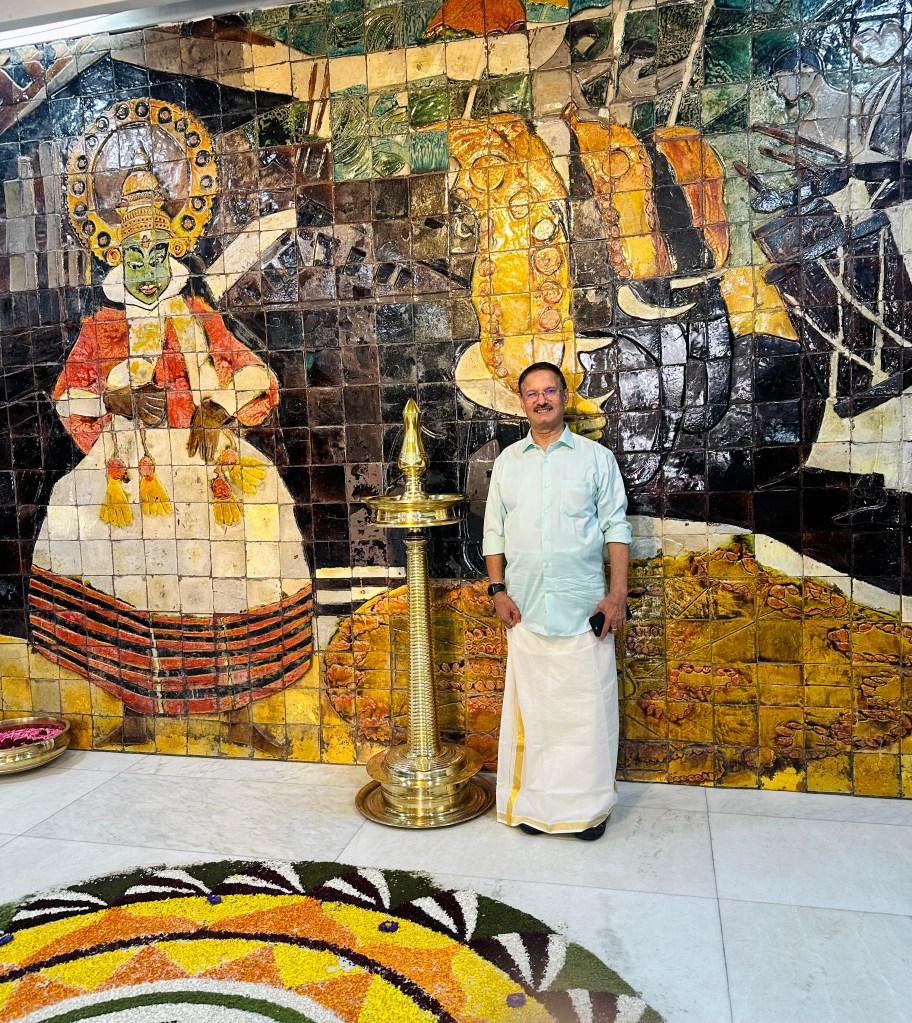
In the first month of the Malayalam New Year – popularly called Chingam – Keralam is in an effortlessly festive mood because, Onam, the harvest festival of Keralam is celebrated during this time around the World. Like previous years, Kerala House in Delhi is hosting a grand Onam Sadhya and cultural programme from August 20–23, 2026. As usual, the celebrations are marked by floral decorations, pookkalams, traditional dresses, and Panch-vadyam. At such events, traditional attire is almost essential: Shirt and Mundu for men, Set-Mundu for women.
As I dug into the delicious piping hot rice and rasam, my mind flashed back to my first Onam in Kerala, 35 years ago.
I had arrived in Wayanad in June 1991 for district training, after almost a year at the IAS Academy in Mussoorie. I instantly fell for its lush green hills, salubrious climate, tea plantations and pristine environment. The months ahead were going to be an education in every sense; learning Malayalam, adapting to unfamiliar food and customs, understanding local systems and, above all, learning to belong.
Coming from Rajasthan, with its scant rainfall and the few remnants of the Aravallis, Kerala’s monsoons and mountains were a revelation. So were Malayalam, the food, and traditions entirely new to a young North Indian officer.
My first real cultural examination came with Onam.
Homes and offices were decorated with flowers and pookkalams. There was an unmistakable air of excitement. Most officers and staff from Wayanad had gone home to celebrate with their families, so the District Collector entrusted me with Mr Francis, the District Planning Officer, who was overseeing Onam programmes and boating operations at Pookot Lake.
Francis suggested I should also attend the Onam functions, beginning with the Onam Sadhya organised by DTPC. His advice: look the part! He suggested that I wear a Shirt and Mundu, the traditional dress for the occasion, and I readily agreed. After all, I had seen Malayali men wearing what looked to me like a white dhoti.
That innocent assumption was to cost me considerable effort.
The Great Mundu Challenge
The first problem was simply how to wear it. I tried wearing it like a lungi. Wrong.
I watched Francis. He wrapped it, folded it, tucked it in and adjusted it – all in a few effortless seconds.
I tried to reproduce the performance. It did not look effortless. I wrapped. I folded. I tucked.
Then I looked in the mirror in my room at the Sugandhagiri Guest House. Something was clearly wrong.
Noticing my predicament, Francis kindly whispered “May I help you Sir?”.
“Yes, please”, I said, surrendering my pride.
He expertly rearranged the folds. “There. Much better now, Sir.”
I looked in the mirror. It seemed all right, but little did I know, the Mundu had rules that were obvious to everyone except me. Even the direction of the front fold could carry cultural and religious significance! Every fold was a new discovery. Clothing, I realised, like language, has its own vocabulary and I was just beginning to learn the alphabet.
Once I had managed to wear the Mundu, I thought the difficult part was over.
Spoiler alert – it wasn’t! Walking in a Mundu was the next humbling challenge, for it felt like a toddler learning to walk again.
I was constantly checking whether the fold was secure, tucked properly and unlikely to slip. My Malayali colleagues walked with complete confidence. I tried to imitate them, with limited success.
And then came the real test: the Onam Sadhya, to be enjoyed sitting on the floor.
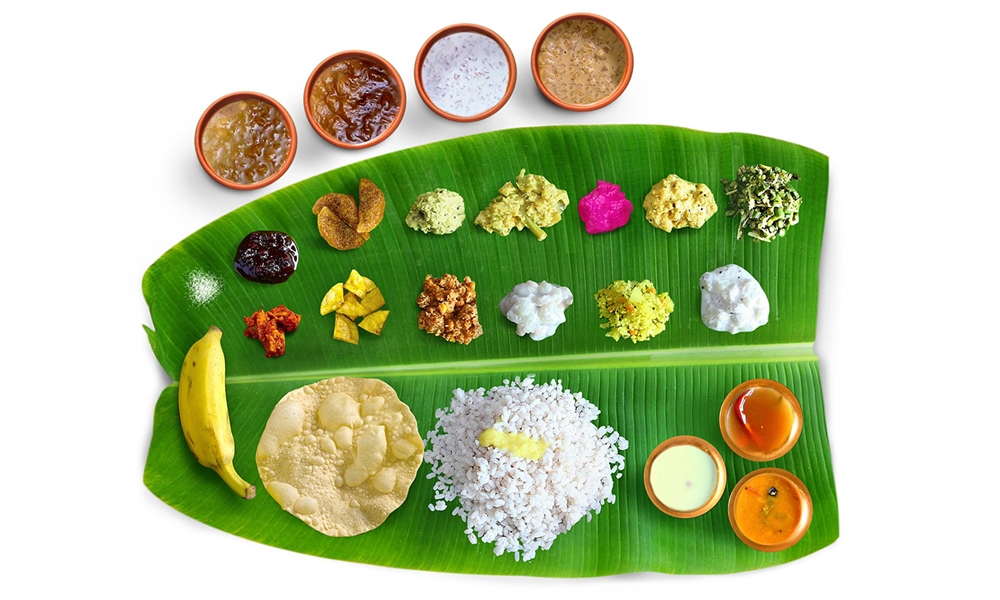
The banana leaf placed before us gradually transformed into a magnificent feast: banana chips, avial, thoran, olan, pachadi, pickles and several other delicacies, followed by rice, sambar, rasam and, of course, two types of payasam.
For everyone else, this was simply Onam lunch.
For me, it was simultaneously a gastronomic experience and a practical examination in Mundu management.
How far could I lean forward? What happened if I shifted position? Would the carefully arranged folds survive my enthusiasm for the food?
Everyone around me was completely relaxed. They ate, talked and laughed. I was attempting all three while keeping one part of my mind permanently assigned to Mundu surveillance.
I remember thinking that eating a Sadhya in a Mundu was nothing short of a Herculean task and truly something I should be able to talk about when someone asks about experience in project management But somewhere between the avial and the payasam, I relaxed. The food was simply too good to allow further anxiety.
Perhaps that was also when I began to feel a little less like an outsider.
The Saturday Mundu
My association with the Mundu did not end with Onam.
In 2009, when I returned from Central deputation to Kerala as Secretary, Industries, the Government decided to promote khadi. As a first step, officials and staff were encouraged to wear khadi to office every Saturday.
By then, I had mastered the basics. I could wear a Mundu myself. I could walk, sit and even eat without wondering whether it was about to betray me.
But I soon discovered another fundamental difference between a Mundu and trousers.
A Mundu has no pockets. This, I felt, was a serious administrative deficiency.
A trouser pocket is one of those conveniences we never appreciate until it disappears. Your everyday essentials – a handkerchief, phone, wallet, keys all have a designated place. The Mundu offered no such infrastructure.
My Saturday routine therefore acquired a new ritual: checking my belongings every time I left home, a meeting or travelled.
Eventually, I solutioned by placing some cash in the shirt pocket, and the phone and keys in a small pouch. What I learned though, was far more important. The absence of pockets was not really a deficiency. It reflected a different philosophy of clothing—simple, functional and unencumbered. The Mundu did not try to carry your life for you. It simply covered you. Perhaps that was enough.
Over time, the Mundu became familiar. I began to appreciate its elegance and simplicity. A white Mundu with a simple shirt seemed perfectly suited to Kerala—comfortable in the heat, graceful without being ostentatious, and deeply connected to the culture.
More importantly, wearing it changed something in me.
I had arrived in Kerala as an outsider. I was learning to become part of the place—not by abandoning where I came from, but by opening myself to the new one.
That, perhaps, was the real lesson of my first Onam.
As a young civil servant, I had imagined that understanding a state would come through files, field visits, meetings and official briefings. Those were important. But some of the most enduring lessons came from simpler experiences—a plate of puttu, a banana leaf overflowing with Sadhya, a conversation with a tribal family, and a white piece of cloth that stubbornly refused to behave the way I expected it to.
The Mundu taught me humility.
The Sadhya taught me patience.
Onam taught me celebration.
And Kerala taught me something that has stayed with me ever since:
To understand a culture, you cannot remain merely an observer. At some point, you have to participate.
Sometimes participation means learning a new language or tasting new food. And sometimes it means standing in front of a mirror, wrestling with 2 meters of white cloth and wondering whether you will ever learn how to wear it properly. I eventually did.
Even today, when I think of my first Onam in Kerala in 1991, I smile.
I remember the flowers.
I remember the Sadhya.
I remember the warmth of the people.
And I remember the Mundu.
It looked so simple. Yet it had humbled a young Assistant Collector before he had even sat down for lunch.
Sometimes, a simple white piece of cloth can teach you more about a place—and about yourself—than a hundred official files.
Kerala Shirt-Mundu
Kerala Onasadhya- (Courtesy-Kerala Tourism)


 Beyond the Files- by Alkesh Sharma
Leave a comment