When I arrived in Thrissur as District Collector in April 1999, it marked two important beginnings in my life. My daughter was born on the very day I was posted as Collector, Thrissur. Ever since, my memories of the district have been inseparable from that personal milestone. Thrissur, celebrated as the Cultural Capital of Kerala, is a city defined by its traditions, festivals, and vibrant community life. The spectacular Thrissur Pooram, with its decorated elephants, rhythmic percussion ensembles, and breathtaking fireworks, reflects the city’s rich cultural heritage.
At the heart of Thrissur stands the thousand-year-old Vadakkunnathan Temple, around which the busy Swaraj Round has evolved. The city’s commercial centre is also intersected by two major national highways, making it one of Kerala’s busiest traffic corridors. As District Collector, I often worried about the growing number of road accidents caused by increasing traffic on roads that had not been designed for such volumes.
One tragic incident in April 2000 changed the course of my tenure. On a busy afternoon at Swaraj Round, a man in his late thirties was knocked down by a vehicle. He remained conscious and pleaded for help, yet although many people gathered around him, no one came forward to assist. He died a few hours later.
I learnt of the incident after returning from an official visit to tribal settlements in Vazhachal. The next morning, newspapers strongly criticised the public’s apparent indifference, questioning how a city known for its culture and compassion could allow such a tragedy to unfold.
Yet I knew the explanation was not simply a lack of humanity. At that time, anyone who helped an accident victim risked prolonged involvement with the police, repeated court appearances, hospital formalities, and possible legal complications. People feared becoming witnesses or being blamed if the victim died. Their hesitation arose from an absence of legal protection and organised emergency support rather than from indifference. The real challenge was to create a system that enabled ordinary citizens to help without fear.
The very next morning, Fr. Francis Alappatt, Director of Jubilee Mission Hospital, visited my office with a small group that had been thinking about this issue for some time. Rather than merely expressing concern, he proposed creating a coordinated emergency response system for accident victims. His initiative prompted discussions with Superintendent of Police S. Ananthakrishnan and representatives of hospitals, NGOs, business organisations, and community leaders.
Together, we examined every obstacle that prevented timely assistance—from public fear of police procedures to delays at hospital reception desks. Gradually, a solution emerged: a community-based voluntary organisation that would work independently while enjoying the confidence and support of the district administration.
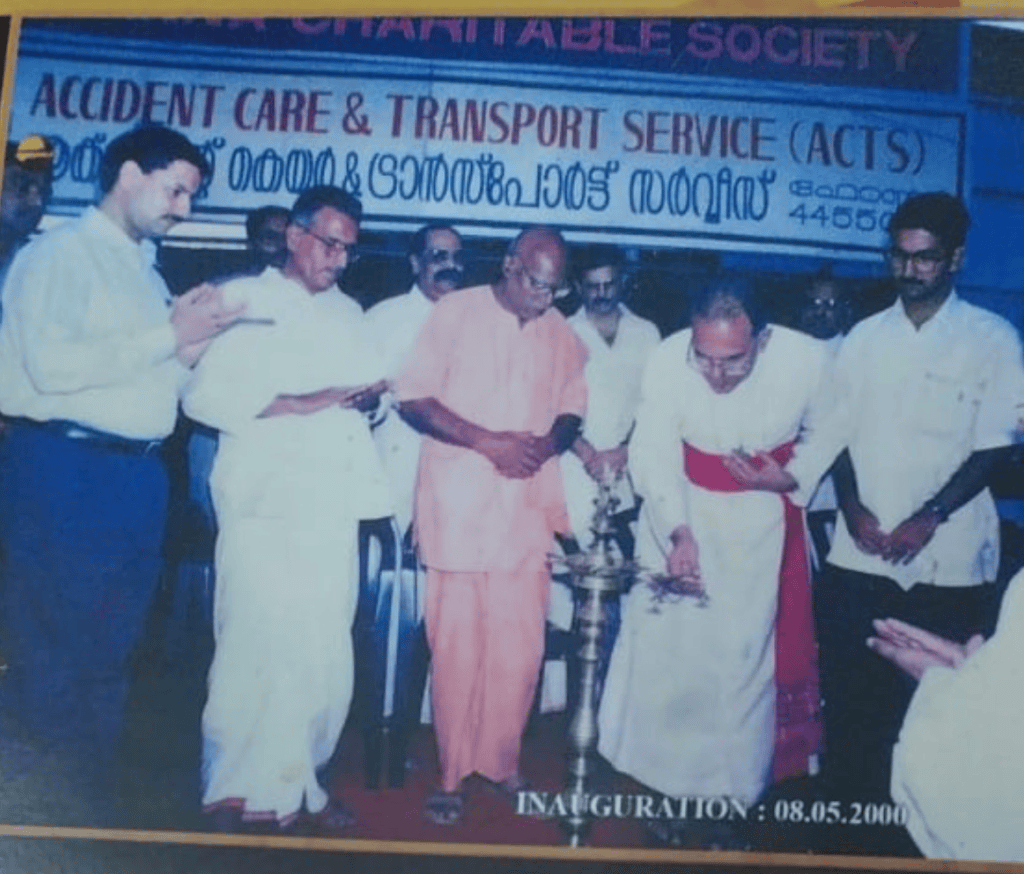
The District Collector became the founding President and the Superintendent of Police the Vice-President, signalling institutional support to hospitals, police, and volunteers. A community representative would manage the organisation’s daily affairs. Although Fr. Francis Alappatt and social activist Chandra Dutt were expected to assume this responsibility, both declined because of prior commitments. Fr. Alappatt instead recommended a young priest, Fr. Davis Chiramel, whose quiet determination and practical thinking convinced us that he was the right person to lead the initiative. On 8 May 2000, the Accident Care and Transport Service (ACTS) was formally launched from a room in the District Hospital, Thrissur.
The new organisation began with almost nothing. It had no ambulances, office, or substantial funds. A membership model was adopted so that individuals and organisations could contribute to an initial corpus. The first major breakthrough came when the General Manager of District Telecom allotted the toll-free emergency number 1099, accessible free of cost throughout the Thrissur telecom circle. In many ways, this memorable number became the foundation of ACTS.
Soon afterwards, Sampanna Charitable Society donated the first ambulance. Volunteers were recruited from colleges, neighbourhoods, and community organisations. Their requirements were simple—a two-wheeler, a working telephone, and a willingness to devote a few hours each day to community service.
Initially, volunteers patrolled important roads and informed hospitals whenever accidents occurred. Since hospital telephone lines were often busy, ACTS established a dedicated dispatch system through 1099, enabling volunteers to directly alert the nearest medical facility and ambulance service.
The organisation’s greatest strength were Fr Francis Alappatt and Fr. Davis Chiramel. They travelled tirelessly across the district, addressing colleges, business associations, and community groups. They built personal relationships rather than relying solely on organisational structures, ensuring that ACTS became a movement owned by the people of Thrissur. This leadership transformed a promising idea into a sustainable institution that continued to expand long after its founders had moved on.
By the time my tenure ended, ACTS had already established itself as a reliable emergency response system. Over the following years, it grew into an organisation with more than 47,000 members and volunteers, 22 ambulances operating round the clock, and 17 branch units across the district. Its volunteers came from every section of society—students, teachers, shopkeepers, professionals, and retirees—united by a common commitment to saving lives. The ambulance services provided to accident victims are without any charge and the organisation survives on donations and support from philanthropic organisations.
More importantly, ACTS transformed public attitudes. It did not expect every bystander to become a medical expert. Instead, it gave citizens a simple and practical responsibility: call 1099. Trained personnel would then take over. By reducing the perceived risks of helping, ACTS encouraged thousands of ordinary people to act instead of remaining passive spectators.
Public awareness campaigns reinforced this transformation. Volunteers visited schools and colleges to explain the importance of the “golden hour”—the critical first sixty minutes after a traumatic injury, when prompt medical attention can determine whether a victim lives or dies. They also clarified what the law required of Good Samaritans, reassuring citizens that helping someone in distress need not result in legal harassment.
One story particularly illustrates this change. A young man who initially drove past an accident later stopped, called 1099, returned to assist the victim, and stayed until help arrived. The victim survived, and the young man subsequently joined ACTS as a volunteer. Such stories demonstrated how removing practical barriers could inspire ordinary people to do the right thing.
The impact of ACTS extended far beyond Thrissur. The Supreme Court of India, recognising that fear of legal entanglement remained one of the country’s most persistent barriers to accident response, directed the Central Government to address the matter. Skandan committee was constituted to frame guidelines for the protection of Good Samaritans. The committee studied several models from across the country, and the Thrissur model was among them. Incidentally, when I was Joint Secretary in the Ministry of Road Transport and Highways, in 2015, we issued “Good Samaritan Guidelines”. The amended Motor Vehicles Act, 2019, in Section 134(1) provides formal legal protection to any person who helps an accident victim reach a hospital. The fear that had killed a man at Swaraj Round in April 2000 is now, at least in its legal dimension, acknowledged and answered.
Looking back, what remains most meaningful is not the creation of an organisation but the culture it helped build. ACTS carries no individual’s name. It belongs to the thousands of volunteers who stop when others need help, answer emergency calls at any hour, and continue serving their communities with compassion. That, to me, is the true purpose of public service—to create institutions and systems that outlast individuals and continue improving lives long after their founders have moved on.
(ACTS doesn’t explicitly solicit donations but welcomes support in terms of more Ambulances, funds for operations and maintenance and logistics. All office bearers work without any remuneration or honorarium).
(Fr Francis Alappatt left for heavenly abode recently after nearly 50 years in Social service and his brother donated an Ambulance in his memory).
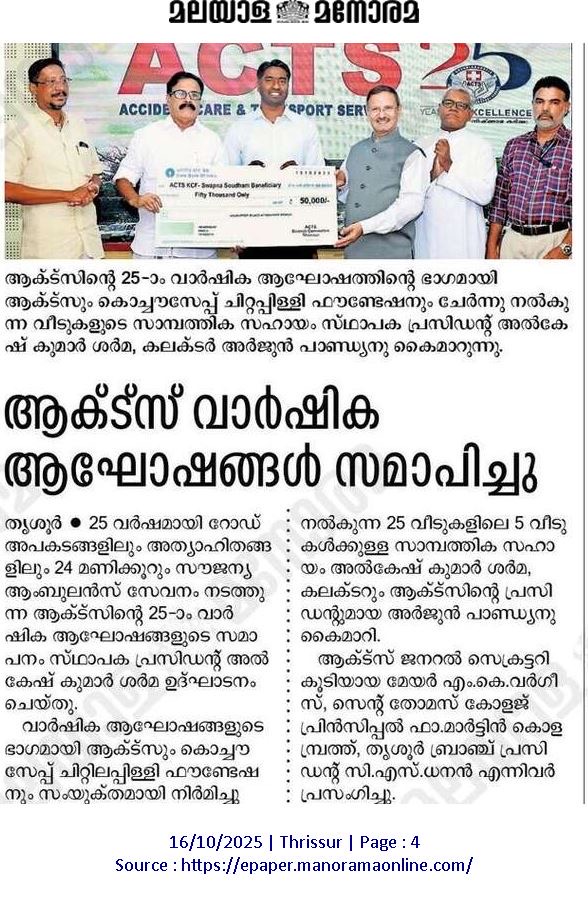
wikipedia.org/wiki/Accident_Care_and_Transport_Service
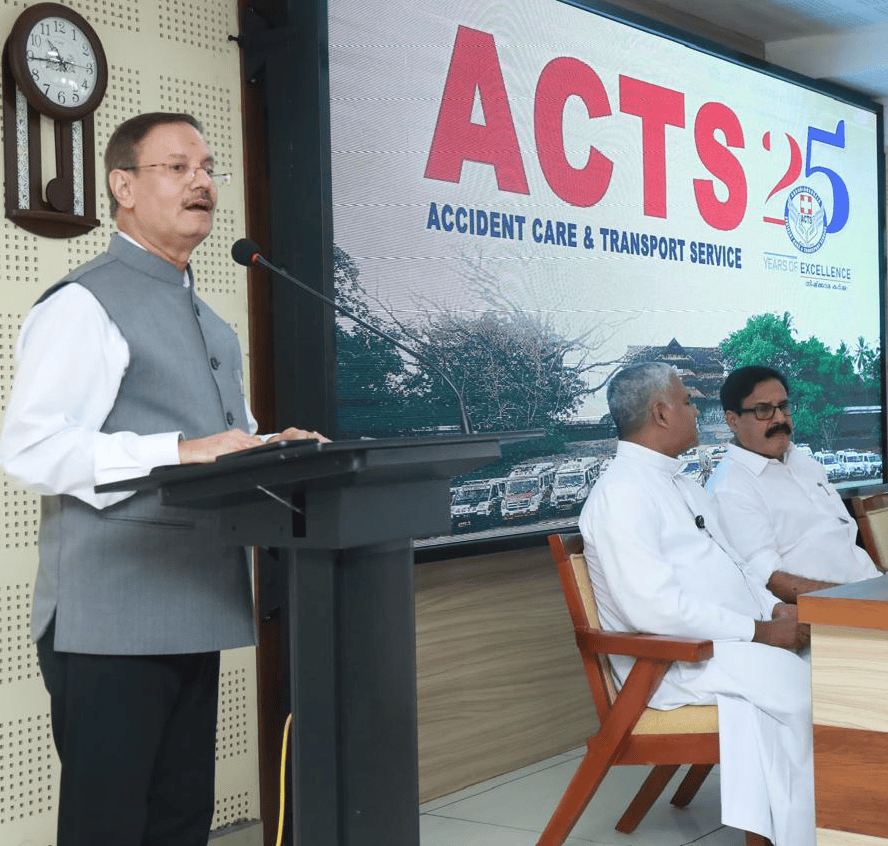
ACTS launch and 25th anniversary (below and above)

 Beyond the Files- by Alkesh Sharma
Leave a comment